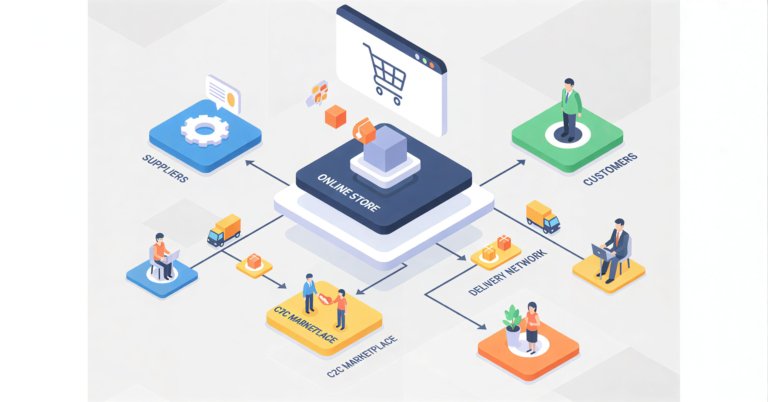
You can feel it, can’t you?
Ecommerce in 2026 isn’t just changing — it’s speeding up.
New tools, changing customer habits, and nonstop competition… everything’s moving fast. And most people? They’re just trying to keep up.
Every day — early in the morning, late at night — people are out there searching. Trying to figure out how to start a store, how to grow one, how to just keep up.
The tricky part is figuring out what actually works now. Not everything does — and what worked last year might already be out of date.
Choosing the right model, at the right moment, can mean the difference between momentum and burnout.
That’s what we’re here to explore. This blog breaks down the ecommerce business models that are actually working in 2026 — and why they matter.
But before we get into the details, let’s rewind a bit.
What are ecommerce business models exactly?
And why does it matter so much before you dive in?
Let’s clear that up first.
Table of Contents
What Are Ecommerce Business Models
An ecommerce business model is like a plan that shows how an online business works and makes money. It explains who the customers are, what products or services are sold, and how people buy things online.
For example, Nike sells shoes and clothes directly to customers using a B2C (business-to-consumer) model. On the other hand, sites like IndiaMART and Alibaba connect manufacturers with retailers, which is called a B2B (business-to-business) model.

The business model also decides how money comes in—whether from selling products, subscriptions, marketplaces, or dropshipping. Picking the right model helps businesses find the right customers, grow faster, and run smoothly.
In short, an ecommerce business model answers important questions:
- Who am I selling to?
- What am I selling?
- How will I make money?
It’s the structure that helps an idea succeed in the digital marketplace.
How Ecommerce Works in Simple Terms
At its core, every online business depends on three essential pillars:
1. Audience – Who You’re Selling To
Your audience defines almost everything you do. The more you understand who they are—what they need, how they shop, and what influences their choices—the easier it becomes to decide what to sell, how to price it, and how to communicate effectively.
There are different types of audiences:
- B2C (Business-to-Consumer): selling directly to everyday shoppers.
- B2B (Business-to-Business): selling products or services to other companies.
- D2C (Direct-to-Consumer): brands selling their own products straight to customers without using middlemen.
Knowing your audience turns selling into solving the right problems for the right people.
2. Value Proposition – What You’re Offering
Your value proposition is your “why.” It defines what makes your store different from others. Maybe your business provides lower prices, better quality, or a smoother shopping experience.
In e-commerce, value extends beyond the product itself—it’s reflected in the way your store communicates, the ease of the buying process, and the overall experience customers remember after they shop with you.
3. Revenue Model – How You Make Money
Every business needs a structure that allows it to earn steadily. Some rely on one-time purchases, while others depend on subscriptions, commissions, or mixed models that combine several sources.
The goal is to build stability over time, creating predictable income that allows your business to plan, grow, and stay flexible when challenges appear.
In real practice, this means choosing products that match demand, building a reliable website, reaching customers through ads or social media, offering simple checkouts, and keeping service smooth long after purchase.
Imagine a small shoe brand selling eco-friendly footwear online. They handle shipping themselves, use smart tools to recommend products, and offer attentive service. Over time, these choices turn an idea into a growing business with loyal buyers.
Choosing the right e-commerce model doesn’t only decide how your store runs—it shapes the journey of your brand. Every decision, from your first visitor to your repeat customer, becomes part of how your business learns, improves, and stays remembered.
Are B2C and D2C the Same Thing
At first, B2C and D2C might sound like just more business jargon — easy to overlook and hard to tell apart. But once you step into e-commerce, you realize these terms describe completely different ways of selling. The path a business chooses—whether selling directly to consumers or through other channels—shapes everything from pricing and marketing to customer relationships. Therefore, understanding the difference between B2C and D2C is useful as its a key step in deciding how your business should grow online.
| B2C (Business-to-Consumer) | D2C (Direct-to-Consumer) |
|---|---|
| Businesses sell products or services directly to customers. | Brands sell their own products directly to customers without middlemen. |
| Can include many sellers on platforms like Amazon or Walmart. | Brand controls the entire process from making to selling. |
| Products often sold through stores, online marketplaces, or other retailers. | Products sold only through the brand’s own website or app. |
| Customers buy from various brands and stores. Examples: Walmart, Amazon, Target. | Customers buy directly from one brand. |
Takeaway
- All D2C businesses are B2C, but not all B2C businesses are D2C.
- B2C can include selling through third-party platforms, which gives reach but limits control.
- D2C focuses on building direct relationships, full control over the brand, and better customer loyalty.
- Choosing the right approach depends on your business goals, product type, and marketing strategy.
Why Ecommerce Business Models Matter
Choosing the right way to run your online business fails to be merely a box to tick — it sets the stage for everything that comes next. Your e-commerce business model determines how money flows, how risks are managed, and how customers interact with your brand. View it as the blueprint for your operations because without it, even a great product can struggle to reach people or make a profit. A strong ecommerce model helps businesses:
- Shows How to Make Money – It helps you know how your online store will earn cash.
- Helps Find Customers – It tells you who you should sell to and how to reach them.
- Makes Selling Easier – It explains the best way to sell your products online.
- Saves Time and Money – Knowing your model helps avoid mistakes that cost time and money.
- Keeps Customers Happy – It helps create a good shopping experience so customers keep coming back.
- Helps Plan for Growth – It shows how to grow your business step-by-step.
- Uses Technology Better – It helps you use websites, apps, and social media in smart ways.
- Shows How to Price – It guides you on setting prices that customers will like and that make you profit.
- Builds Trust – A clear plan helps customers feel safe buying from you.
- Prepares for Problems – It helps you think ahead and avoid problems before they happen.
The Main Types of Ecommerce Business Models
Ecommerce businesses come in many shapes and directions, each carrying its own mix of advantages and challenges. Understanding these differences shows why knowing the main types matters—it’s essential for growth and long-term success. Each model opens distinct possibilities but also calls for careful decisions. Hence, learning how they work helps businesses choose the right path, make stronger moves, and stay competitive in an online space that keeps evolving.
When the flow extends beyond what’s being sold, it highlights how each decision shapes customer experience and satisfaction. Aligning these elements allows a business to move past simply existing and start creating a lasting impact with purpose.
1. B2C (Business-to-Consumer)
Businesses sell directly to individual customers. This is the most common model for online stores.
- Example (India): Nykaa – beauty and personal care products.
- Example (Global): Nike – selling shoes and apparel online.
- Revenue Model: Direct product sales.
2. B2B (Business-to-Business)
Businesses sell products or services to other businesses, often in bulk or through long-term contracts.
- Example (India): IndiaMART – connecting manufacturers and suppliers with retailers.
- Example (Global): Alibaba – global wholesale marketplace.
- Revenue Model: Bulk orders, subscription plans, or commission on transactions.
3. C2C (Consumer-to-Consumer)
Individuals sell to each other via a platform that facilitates transactions.
- Example (India): OLX, Quikr – users sell second-hand items.
- Example (Global): eBay – peer-to-peer selling platform.
- Revenue Model: Listing fees, commissions, or ads.
4. C2B (Consumer-to-Business)
Consumers provide products or services to businesses. Often seen in freelancing or user-generated content models.
- Example (India): Freelancers on Upwork or Fiverr providing services to companies.
- Example (Global): 99designs – designers sell to businesses.
- Revenue Model: Commission on service fees.
5. D2C (Direct-to-Consumer)
Brands sell directly to customers, eliminating intermediaries and controlling the customer experience.
- Example (India): Mamaearth – skincare and personal care products.
- Example (Global): Warby Parker – eyewear sold online.
- Revenue Model: Direct sales, subscriptions, or bundles.
6. Subscription-Based Ecommerce
Customers pay regularly (weekly, monthly, or yearly) for recurring products or services.
- Example (India): Bluestone subscription jewelry boxes.
- Example (Global): Dollar Shave Club – grooming kits delivered regularly.
- Revenue Model: Recurring subscription fees.
7. Marketplace Model
Platforms connect multiple sellers with buyers and earn a commission on each transaction.
- Example (India): Amazon India, Flipkart Marketplace.
- Example (Global): Etsy, eBay.
- Revenue Model: Commission, listing fees, ads.
8. Dropshipping
Stores sell products they don’t stock; suppliers ship directly to customers.
- Example (India & Global): Many Shopify stores use dropshipping for clothing, gadgets, or home products.
- Revenue Model: Difference between selling price and supplier cost.
9. Wholesale Model
Businesses sell large quantities of products to retailers at discounted prices.
- Example (India): TradeIndia, IndiaMART.
- Example (Global): Alibaba.
- Revenue Model: Bulk discounts and volume sales.
10. Freemium / Digital Products
Basic services are free, but customers pay for premium features or digital content.
- Example (India): BYJU’S, free lessons with paid courses.
- Example (Global): Canva Pro, premium design features.
- Revenue Model: Subscription or one-time payment for premium features.
11. Social Commerce
Selling products directly via social media platforms.
- Example (India): Meesho – resellers promote products on WhatsApp/Instagram.
- Example (Global): Instagram Shops, Facebook Marketplace.
- Revenue Model: Commission on sales or platform fees.
12. Crowdfunding / Pre-Order Ecommerce
Products are funded by pre-orders before production, reducing risk for sellers.
- Example (Global): Kickstarter, Indiegogo.
- Example (India): Ketto (crowdfunding for products and causes).
- Revenue Model: Percentage of funds raised or product sales.
13. Hybrid Ecommerce Models
Many businesses today combine multiple models to maximize reach and revenue.
- Example (India): Flipkart combines B2C sales with a marketplace for third-party sellers.
- Example (Global): Amazon combines B2C, B2B (Amazon Business), and marketplace.
Hybrid models offer several advantages:
- Multiple revenue streams from different types of sales.
- Greater customer reach by targeting both consumers and businesses.
- Flexibility to adapt to market trends and customer preferences.
- Scalability without relying solely on one type of transaction.
Hybrid ecommerce models allow businesses to blend different strategies, reduce risk, and create a more resilient online operation.
How to Choose the Right Ecommerce Business Model
You’ve probably explored a few online stores, compared platforms, or even started experimenting with selling, but now the question is: how do you run your store in a way that truly works for you? At this stage, the focus is not just on getting online but also on making decisions that shape your daily operations. Choosing the right business model now helps you align your products, audience, and goals, so every action moves your store closer to sustainable growth instead of relying on trial and error. Below is a practical, step-by-step guide to help you make that choice clearly and confidently.
1. Identify Your Target Audience
Understanding who your customers are is the first step.
- Are you selling to individual consumers or other businesses?
- Do your customers prefer direct purchases, subscriptions, or marketplaces?
Example: If your customers are everyday shoppers, a B2C model like Nykaa may fit. If you target retailers or manufacturers, B2B like IndiaMART is better.
2. Determine Your Product Type
Different products suit different models:
- Digital products or services work well with freemium, subscription, or D2C models.
- Bulk physical goods may favor B2B or wholesale models.
- Unique or niche items can thrive in marketplaces or D2C stores.
3. Consider Your Revenue Strategy
How will your business make money?
- Direct sales? (D2C/B2C)
- Recurring revenue? (Subscription model)
- Commissions or marketplace fees? (Marketplace model)
- Service fees or digital product upgrades? (C2B/Freemium)
4. Evaluate Operational Capabilities
Think about your inventory, logistics, and fulfillment abilities:
- Can you stock products or rely on dropshipping?
- Do you have the infrastructure for bulk shipments (B2B)?
- Can you handle subscription deliveries efficiently?
5. Analyze Competition and Market Trends
Study competitors and the market landscape:
- Which models are successful in your niche?
- Are there underserved segments you can target with a hybrid approach?
- Example: Flipkart combines B2C sales with a marketplace for third-party sellers to capture more market share.
6. Factor in Scalability and Flexibility
Your model should allow for growth:
- Can it adapt to changing customer needs?
- Can you add new products, services, or revenue streams later?
- Hybrid models are often ideal for flexibility, combining D2C, subscription, and marketplace strategies.
7. Test and Iterate
The right model may not be obvious initially. Start small, track results, and adjust based on performance, customer feedback, and profitability. Many successful ecommerce businesses pivot their models after launch.
Key Differences Between B2B and B2C Ecommerce
| Aspect | B2B (Business-to-Business) | B2C (Business-to-Consumer) |
|---|---|---|
| Target Audience | Other businesses, retailers, or wholesalers | Individual consumers |
| Example (India) | IndiaMART – connecting manufacturers and suppliers with retailers | Nykaa – selling beauty and personal care products online |
| Example (Global) | Alibaba – global wholesale marketplace | Nike – selling shoes and apparel online |
| Transaction Volume | Typically large orders in bulk | Usually single-unit or small quantity purchases |
| Decision-Making Process | Longer, involves multiple stakeholders, often negotiated | Quick, individual decision-making, influenced by emotions and personal preferences |
| Pricing | Negotiated, bulk discounts, flexible pricing strategies | Fixed pricing or promotional discounts; pricing sensitive to market trends |
| Sales Cycle | Longer, may involve contracts, recurring orders, and negotiations | Shorter, usually immediate purchase based on need or impulse |
| Marketing Approach | Focuses on relationship-building, personalized offers, and account-based marketing | Focuses on advertising, branding, social media, and promotions to attract individual buyers |
| Customer Support | In-depth support, account managers, and long-term service agreements | Standard support channels, FAQs, and quick assistance for individual buyers |
| Revenue Model | Bulk sales, recurring contracts, long-term partnerships | Single transactions, repeat purchases, upsells, and cross-sells |
| Technology & Platform Needs | Complex ERP integration, customized catalogs, B2B-specific features | User-friendly interface, easy checkout, fast delivery, and responsive design |
Which Ecommerce Model Works Best for Small Businesses
For small businesses, choosing an e-commerce model is like selecting the right vehicle for a journey. You might have the destination in mind that could be selling products online and growing your brand — but the way you move forward lies on the vehicle you choose. Some models let you move fast with minimal investment, others require more planning and resources but offer stability and control.

Therefore, instead of asking which model is “best,” the real question is: which model aligns with your current capacity, your audience, and the type of products you offer? The goal is to decide on a path that allows you to start confidently, learn as you go, and scale without overextending. When your business model matches your reality, every decision — from marketing to inventory to pricing — becomes simpler, clearer, and more effective.
1. D2C (Direct-to-Consumer) – Small brands sell products directly to customers without intermediaries.
It suits small businesses because:
- Full control over branding and customer experience
- Higher profit margins by eliminating middlemen
- Easier to build a loyal customer base
Example: Mamaearth (skincare products) delivers directly to customers in India.
2. B2C (Business-to-Consumer) – Small businesses sell products online directly to individual consumers, either through their own store or platforms.
Small businesses find this helpful because:
- Quick sales cycle with straightforward transactions
- Easy to market on social media and reach local or niche audiences
- Simple to scale gradually with demand
Example: Local artisan shops or niche ecommerce stores using Shopify.
3. Dropshipping Model – The business sells products without holding inventory; the supplier ships directly to customers.
Well-suited for small businesses as it:
- Low startup costs, as no inventory is required
- Reduced risk, especially for new or experimental products
- Ability to test different products quickly
Example: Many Shopify dropshipping stores selling gadgets, home décor, or fashion items.
4. Subscription-Based Model – Customers pay regularly for recurring products or services.
Supports small business success by:
- Provides predictable recurring revenue
- Builds long-term customer relationships and loyalty
- Ideal for consumables like beauty, wellness, or food products
Example: Bluestone subscription jewelry boxes or snack subscription boxes.
5. Marketplace Model (Third-Party Platforms) – Small businesses sell through marketplaces like Amazon, Flipkart, or Meesho instead of setting up their own store.
Favorable for small business owners because:
- Access to a large customer base without heavy marketing
- Easier logistics through marketplace fulfillment programs
- Lower technical barriers for starting an online business
Example: Handmade goods or apparel sold on Meesho or Amazon India.
Key Considerations for Small Businesses:
- Startup Cost: Dropshipping or marketplaces reduce initial investment.
- Control Over Brand: D2C gives full control over brand image and customer experience.
- Scalability: Subscription models and marketplaces offer room to scale gradually.
- Operational Capacity: Small teams may benefit from simpler models (B2C, dropshipping, marketplace) instead of complex B2B operations.
For small businesses, the best ecommerce model depends on resources, product type, and target audience. Many small businesses start with D2C, B2C, dropshipping, subscriptions, or marketplaces because these models require lower upfront costs, offer flexibility, and allow gradual scaling. Some models from the larger list—like B2B, wholesale, or hybrid models—are better suited for larger businesses with more resources and teams. Combining models can also maximize reach and profitability over time.
How Product Type Affects Your Ecommerce Model Choice
Products are all different, and that changes how a business sells them online. Come rain or shine, some things need careful packing, some need to be restocked a lot, and some have to be delivered super fast. Knowing how your product works helps you settle on the best way to sell it, which can make customers happy and help your business grow better.

1. Physical Products
Tangible items that customers can touch and use. For instance – Apparel, electronics, home goods, beauty products.
Suitable Models:
- B2C: Ideal for selling directly to consumers through your own store. Example: Nykaa selling beauty products online.
- D2C: For brands wanting to retain full control over branding and margins. Example: Mamaearth selling directly to customers.
- Dropshipping: Great for small businesses testing new products without inventory risk. Example: Shopify stores selling gadgets or fashion items.
- Marketplace Model: Reaching a large audience without managing your own marketing. Example: Selling products on Amazon India or Meesho.
2. Digital Products
Non-physical goods like software, eBooks, or online courses. For instance – Software, eBooks, online courses, templates.
Suitable Models:
- D2C: Selling directly ensures you control distribution and customer experience. Example: BYJU’S selling digital courses directly.
- Subscription-Based Model: Ideal for SaaS products or recurring digital content. Example: Canva Pro or online learning platforms.
- Freemium / C2B: Basic versions free, premium paid. Example: Design platforms offering upgrades to paid tiers.
3. Niche or Unique Products
Specialized items targeting a specific group or need. For instance -Handmade crafts, limited edition items, artisanal goods.
Suitable Models:
- B2C / D2C: Helps build a loyal customer base that values uniqueness. Example: Etsy-like stores in India selling handmade jewelry.
- Marketplace Model: Platforms help reach audiences beyond your geographic limits. Example: Amazon Handmade or Meesho.
4. Bulk or Wholesale Products
Large quantities of goods sold at lower prices to retailers or businesses. For instance – Industrial supplies, office furniture, raw materials.
Suitable Models:
- B2B: Selling directly to other businesses in bulk. Example: IndiaMART connecting suppliers to retailers.
- Wholesale / Hybrid: Businesses may combine B2B with marketplace listings for wider exposure. Example: Alibaba for global wholesale buyers.
5. Subscription / Consumable Products
Products customers receive regularly through recurring payments. For instance – Coffee, snacks, cosmetics, vitamins.
Suitable Models:
- Subscription-Based Model: Ensures recurring revenue and convenience for repeat purchases. Example: Bluestone subscription jewelry boxes or snack subscription services.
- D2C / B2C Hybrid: Allows direct interaction with customers while offering occasional bulk promotions.
Key Considerations When Matching Product Types to Models:
- Inventory & Fulfillment: Physical products require storage, logistics, and shipping; digital products do not.
- Sales Cycle: Consumables benefit from subscriptions; unique or high-end products may need longer decision cycles.
- Customer Behavior: Digital products attract tech-savvy buyers; niche products attract collectors or enthusiasts.
- Revenue Strategy: Subscription models are ideal for recurring needs, while B2B suits bulk transactions.
The kind of product you’re selling largely determines which e-commerce business model will work best for you.
- If you’re selling physical or niche products, models like B2C (business to consumer), D2C (direct to consumer), dropshipping, or selling on marketplaces usually work well.
- If you’re selling digital products, models like subscriptions, freemium (free basic + paid upgrades), or D2C are often a better fit.
- If you’re selling bulk items, then B2B (business to business) or wholesale models make more sense.
The key point is that your choice should depend on what you’re selling, who your customers are, and what your business can handle operationally. Choosing the right model this way helps you make sales efficiently and become profitable.
The Risks That Come with Different Ecommerce Models
Every e-commerce business model comes with its own set of challenges. What works well for one type of store might create unexpected hurdles for another. Identifying potential risks before committing helps you plan to avoid costly mistakes and make informed decisions for growth. By examining the vulnerabilities and trade-offs of each approach, you can choose a model that not only fits your products and audience but also positions your business for long-term stability.
| Ecommerce Model | Description | Main Risks | Example |
|---|---|---|---|
| B2C | Selling directly to individual consumers | High competition, price sensitivity, expensive marketing, returns & refunds | Nykaa |
| B2B | Selling products/services to other businesses | Long sales cycles, dependence on few clients, complex operations | IndiaMART |
| C2C | Consumers selling to other consumers via a platform | Trust issues, platform dependency, fraud or disputes | OLX, Quikr |
| C2B | Consumers sell products/services to businesses | Pricing challenges, limited reach, platform dependency | Upwork |
| D2C | Brands sell directly to customers | Marketing burden, operational costs, building customer trust | Mamaearth |
| Subscription | Recurring payments for products/services | Customer churn, inventory planning, high expectations | Bluestone subscription boxes |
| Marketplace | Platforms connect multiple sellers to buyers | Competition among sellers, dependency on platform rules, quality control | Amazon India |
| Dropshipping | Products shipped directly by supplier | Supplier reliability, lower margins, limited control | Shopify dropshipping stores |
| Wholesale / Bulk | Large quantity sales to businesses or retailers | Dependence on few clients, cash flow delays, logistics complexity | TradeIndia |
| Freemium / Digital Products | Basic free services; premium paid | Low conversion, piracy, continuous updates needed | Canva Pro |
| Social Commerce | Selling via social media platforms | Algorithm dependency, high competition, customer trust | Meesho resellers |
| Crowdfunding | Products funded by pre-orders before production | Funding failure, delayed delivery, limited audience | Kickstarter gadgets |
| Hybrid | Combination of multiple models | Operational complexity, higher costs, focus dilution | Flipkart |
How Competition Differs Across Ecommerce Models
In e-commerce, competition reflects how different businesses operate and the choices they make in their model. Some markets are flooded with similar products, where standing out requires mastering pricing, speed, and promotions. Others are less crowded but demand a strong story, excellent service, or a niche audience that values uniqueness over cost. By understanding existing players and their approaches, even small businesses can find a space to thrive and grow with confidence, turning a crowded market into a landscape of opportunities rather than obstacles.
Here’s a full breakdown by model –

1. B2C (Business-to-Consumer)
Nature of competition: Very High
B2C is the most crowded model since anyone can launch an online store. Competing on price, speed, and customer experience is tough. Success depends on brand differentiation, consistent quality, and customer loyalty.
Example: Nykaa competes with Amazon, Flipkart, and countless D2C beauty brands.
Why it’s competitive:
- Low entry barriers
- Heavy marketing requirements
- Short customer attention spans
If you enter early in a niche category, you can lead and shape market expectations. But if you join when the space is already saturated, you’ll fight price wars and struggle for visibility without a strong brand story.
2. B2B (Business-to-Business)
Nature of competition: Moderate
Fewer players, but competition is relationship-driven, not just pricing. It requires specialization, credibility, and supply reliability.
Example: IndiaMART competes on network size, trust, and sourcing efficiency.
Why it’s less saturated:
- Higher entry barriers
- Requires credibility and strong supply chain
- Fewer, larger clients instead of mass consumers
Entering early allows you to build trust and long-term contracts with key buyers. Joining later means competing with entrenched networks — success will depend on niche expertise and personalized service.
3. D2C (Direct-to-Consumer)
Nature of competition: High but Niche-Focused
You compete directly with other brands and marketplaces. Brand identity, storytelling, and trust are your strongest weapons.
Example: Mamaearth competes with both local startups and global giants.
What matters:
- Strong storytelling
- Distinct product quality
- Loyal community-building
Once you enter early in a growing niche (e.g., clean beauty or sustainable fashion) this helps you own the narrative. Latecomers face ad fatigue, rising CAC, and higher branding costs to differentiate.
4. Dropshipping
Nature of competition: Very High and Price-Sensitive
Many sellers use the same suppliers, making differentiation difficult. The competition is driven by trending products and price wars.
Example: Generic Shopify stores selling trending gadgets or apparel.
Risks:
- Easy entry leads to market saturation
- Profit margins can shrink quickly
Initial adopters of a new product trend can scale fast. Late entrants often face overexposed products, increased ad costs, and vanishing margins.
5. Marketplace Model
Nature of competition: Internal + External
Sellers compete both within the platform and against the platform’s own brands.
Example: Amazon sellers compete with Amazon Basics and thousands of peers.
Factors driving competition:
- Product visibility (search ranking)
- Ratings and reviews
- Pricing strategy
Early sellers benefit from platform algorithms, easier ranking, and lower ad spend. Late entrants must rely heavily on paid ads and SEO optimization to gain traction.
6. Subscription Model
Nature of competition: Moderate but Retention-Focused
Fewer players, but customer retention is the main challenge. You’re competing for long-term loyalty, not just one-time sales.
Example: Bluestone jewelry subscriptions or snack boxes.
Challenges:
- Consistent value delivery
- Managing churn and engagement
First movers in emerging categories can set pricing expectations and habits. Later entrants must innovate with personalization or bundled value to reduce churn.
7. Freemium / Digital Products
Nature of competition: Moderate
Competition centers around features, usability, and value, not logistics. Once users commit, churn is low.
Example: Canva vs. Figma or other design tools.
Key Edge: Innovation and upgrades over pure marketing
If you enter early, you can build user habits and industry standards. Latecomers must out-innovate leaders or target underserved micro-niches.
8. Social Commerce
Nature of competition: High + Platform-Driven
Here, you compete for attention, not just conversions. Algorithms and influencer dominance shape visibility.
Example: Meesho resellers or Instagram boutique stores.
Why it’s tough:
- Constant need for fresh content
- Platform algorithm changes
- Influencer partnerships dominate reach
Front-runners enjoy better reach at lower cost. Late entrants face expensive ads and need stronger content strategy or unique storytelling to stand out
9. C2C (Consumer-to-Consumer)
Nature of competition: Moderate but Trust-Based
Relies on platform reputation, user reviews, and location-based convenience.
Example: OLX, Quikr — sellers compete on price, location, and quality.
Leading sellers can gain trust through reviews and local presence. Late entrants must work harder to build reputation and visibility through quality listings.
10. Hybrid Models
Nature of competition: Complex
Operate across multiple fronts (B2C + Marketplace + Subscription). Great for reach, but resource-heavy and complex to manage.
Example: Flipkart operates in both B2C and marketplace spaces.
Initial entrants in hybrid categories can define category expectations. Late entrants must bring strong infrastructure and clear brand positioning to avoid spreading too thin.
Key Insights:
| Competition Level | Models | Why |
|---|---|---|
| Very High | B2C, D2C, Dropshipping, Social Commerce | Easy entry, low differentiation, price wars |
| Moderate | B2B, Subscription, Freemium, C2C | Relationship-based, retention-focused |
| Complex | Hybrid Models | Multi-channel competition, high resource demand |
If you’re starting out, choose a model where your unique value stands out — like niche D2C, freemium digital products, or subscription services. Avoid battling in overcrowded, price-sensitive markets unless you have strong differentiation or early entry advantage.
Which Ecommerce Model Has the Lowest Start-Up Cost
Every new online business faces the challenge of startup costs. Some e-commerce models require significant investments in inventory or marketing, others allow you to get started with minimal expenses. The key is finding the right balance between what you can afford and what your business needs to grow. By exploring cost-effective options, entrepreneurs can turn a potential hurdle into a stepping stone for success, focusing on growth rather than getting stuck on spending.
| Ecommerce Model | How It Works | Why It Has Low Startup Cost | Example |
|---|---|---|---|
| Dropshipping | Products are sold without holding inventory; supplier ships directly to customers | No need to buy stock upfront or maintain a warehouse; easy to test products | Shopify stores selling gadgets, fashion, or home décor |
| Marketplace Model | Sell through platforms like Amazon, Flipkart, or Meesho | No need for a personal website or complex logistics; access to a ready-made audience | Small sellers on Meesho selling handmade crafts or apparel |
| Freemium / Digital Products | Sell digital goods or services (eBooks, templates, courses) | No inventory, shipping, or storage required; products can be sold repeatedly | Canva templates, online courses, downloadable guides |
| D2C / B2C with Inventory | Selling products directly to consumers via own store | Requires upfront investment for stock, warehousing, and shipping | Mamaearth, Nykaa |
| B2B / Wholesale | Selling in bulk to businesses or retailers | High upfront costs for inventory and logistics; larger financial risk | TradeIndia, IndiaMART |
How AI and Automation Are Changing Ecommerce Business Models
AI and automation are transforming how online businesses operate. What was once an optional tool has become essential for selling products, managing operations, and connecting with customers. E-commerce models themselves are shifting as companies that embrace AI and automation can grow faster, adapt more effectively to market changes, and offer experiences that stand out from the competition. Therefore, the key question is not whether AI is changing e-commerce, but how it will shape the future of every online business.
Product & Inventory Management
| AI / Automation Role | Impact on Business Model | Resulting Model Shift |
|---|---|---|
| Predictive Demand Forecasting | Uses AI to analyze buying patterns, seasonal demand, and regional trends. | Shifts from reactive inventory management to proactive, data-led stocking. |
| Dynamic Replenishment Systems | Automated restocking via real-time analytics. | Reduces warehousing costs, enables lean D2C models and just-in-time dropshipping. |
| AI Product Development | Tools like generative design and AI-led trend prediction help businesses launch faster. | Speeds up D2C innovation and private label creation for B2C marketplaces. |
Marketing & Customer Acquisition
| AI Use Case | Effect | Business Model Change |
|---|---|---|
| Personalized Marketing (AI-driven) | Hyper-targeted ads, personalized email flows, and content. | Enables high-ROI D2C strategies by reducing CAC (Customer Acquisition Cost). |
| AI Chatbots / Assistants | 24×7 support reduces reliance on human agents. | Empowers leaner support teams, better scalability for small sellers. |
| Automated Influencer Matching | AI finds ideal influencers for niche audiences. | Favors micro-D2C and niche brand growth. |
Operations & Fulfillment
| Automation Tool | Effect | Business Model Evolution |
|---|---|---|
| Automation Tool | Effect | Business Model Evolution |
| Warehouse Robotics | Faster, error-free picking & packing. | Supports fast-scaling fulfillment models (Quick Commerce, Subscription). |
| Smart Routing Algorithms | AI chooses optimal courier or route. | Improves delivery reliability → competitive edge in B2C & D2C. |
| Automated Returns Management | Self-service return flows. | Reduces overhead, improves customer trust — essential for marketplace sellers. |
Pricing & Profitability
| AI Pricing Tools | Effect | Shift in Model |
|---|---|---|
| Dynamic Pricing Engines | Continuously adjust prices based on demand, competitors, and seasonality. | Encourages adaptive pricing models vs. fixed-price D2C. |
| Margin Optimization Algorithms | Suggests ideal pricing for profit goals. | Improves hybrid models (B2B2C, omnichannel) where margins vary. |
Customer Experience & Retention
| AI Tech | Impact | Model Shift |
|---|---|---|
| Recommendation Engines | Boosts AOV (Average Order Value) via smarter upsells. | Strengthens personalized commerce (Netflix-style stores). |
| Conversational AI | AI assistants that guide customers across channels. | Enables AI-led CX, blending ecommerce with human-like service. |
| Emotion AI / Sentiment Analysis | Monitors customer satisfaction in real time. | Allows predictive retention → crucial for subscription-based models. |
New Emerging AI-Driven Business Models
| Model | How AI Enables It | Example / Trend |
|---|---|---|
| AI-First D2C Brands | Use AI for design, supply chain, marketing. | Brands that launch & iterate fully via AI insights. |
| Automated Dropshipping 2.0 | AI curates winning products & syncs suppliers. | Low-cost, low-risk microbrands run fully automated. |
| Subscription Commerce | AI predicts reorder cycles & automates fulfillment. | Coffee, skincare, vitamins auto-refill. |
| Headless AI Commerce | AI controls back-end logic; front-end is modular. | Flexible omnichannel selling with personalization. |
| Social Commerce via AI Creators | AI influencers promoting AI-curated products. | Merging entertainment + commerce. |
Global Scalability & Localization
| AI Function | Outcome | Model Impact |
|---|---|---|
| Auto Translation & Localization | Instantly adapts stores for multiple markets. | Enables borderless B2C/D2C selling. |
| Currency & Tax Automation | Handles multi-region compliance. | Expands cross-border marketplace reach. |
Disclaimers
- Adoption Gap: AI tools help, but success depends on data quality and business readiness.
- Ethical Concerns: Automation at scale may raise privacy, bias, and job displacement issues.
- Cost vs. ROI: Some AI tools have steep setup costs — feasible for D2C and B2B, less for micro-dropshippers.
AI and automation aren’t just supporting tools anymore — they’re strategic enablers driving leaner, smarter, and more personalized ecommerce models.
Ending Thought
Most people never notice the moves that separate average stores from ones that explode overnight. The truth is out there, but only those paying attention can spot it, adapt, and win. If you want your store to stand out, don’t wait for someone else to set the pace. Step in, experiment, and make your next move count—before the opportunity disappears.
FAQs on Ecommerce Business Models
1. Which Ecommerce Business Model is Most Profitable?
When thinking about which ecommerce business model makes the most money, it’s not always simple. It really depends on what you’re selling, who you’re selling to, how well you run your business, and the plan you follow. But some types usually do better than others:
• Direct-to-Consumer (D2C): Companies like Mamaearth and Boat sell their products straight to customers. This way, they don’t have to share profits with middlemen and can keep more money.
• Business-to-Business (B2B): Sites like IndiaMART sell big orders to other businesses, which means steady and reliable income.
• Subscription Models: Businesses like Bluestone or Dollar Shave Club get money regularly from customers who sign up for monthly or yearly plans, so they know what to expect.
• Hybrid Models: Big companies like Flipkart or Amazon mix different ways of selling, like direct sales, marketplaces, and subscriptions. This helps them earn money from many places and stay safe from risks.
In the end, the most profitable model is the one that works best because of how well it’s done and how happy the customers are. It’s not just about the idea but how smartly it’s managed.
2. Which Ecommerce Models Are Easier to Scale?
They are –
• Dropshipping: No need to manage inventory, so it’s simple to add new products or enter new markets quickly. Example: Many Shopify dropshipping stores can try different niches without big upfront costs.
• Marketplace Model: You use a platform’s existing audience and logistics, making it easier to add products or sell in new locations. Example: Sellers on Amazon or Meesho can grow fast without building their own systems.
• Digital / Freemium Products: These can be sold worldwide with minimal extra cost, since there’s no physical inventory or shipping. Example: Canva Pro or online courses can serve millions without limits.
• Subscription-Based Model: Predictable recurring revenue and easier to add subscribers once systems are set up. Example: Bluestone jewelry or snack subscription boxes.
3. Which Ecommerce Models Are Harder to Scale?
They are –
• Dropshipping: No need to manage inventory, so it’s simple to add new products or enter new markets quickly. Example: Many Shopify dropshipping stores can try different niches without big upfront costs.
• Marketplace Model: You use a platform’s existing audience and logistics, making it easier to add products or sell in new locations. Example: Sellers on Amazon or Meesho can grow fast without building their own systems.
• Digital / Freemium Products: These can be sold worldwide with minimal extra cost, since there’s no physical inventory or shipping. Example: Canva Pro or online courses can serve millions without limits.
• Subscription-Based Model: Predictable recurring revenue and easier to add subscribers once systems are set up. Example: Bluestone jewelry or snack subscription boxes.
4. What Important Factors to Keep in Mind When Choosing an Ecommerce Model to Ensure It Scales Well?
They consist of –
• Simple models tend to scale faster: Dropshipping, marketplaces, digital products, and subscriptions usually grow easier.
• Complex models need more resources: Inventory-based and B2B setups require more capital, staff, and infrastructure.
• Planning matters: Even the easiest models need good strategies to keep quality and customer happiness as you grow.
5. What Makes Some Business Models Grow Faster?
Business growth rarely happens by chance. Some models scale rapidly, capturing attention and revenue, while others move slowly despite similar resources. The difference lies in strategy, structure, and execution.
Studying why certain business models grow faster can provide valuable insights for anyone looking to scale effectively.
• Low barrier to entry for sellers (marketplaces, social commerce).
• Consumer demands for convenience (fast delivery, easy returns, mobile checkout).
• Rich data & personalization (brands that use data for customer experience tend to grow faster, especially D2C and B2C).
• Technological improvements (better infrastructure, payments, logistics).
• Changing consumer behavior post-pandemic, more digital adoption, more comfort buying online.
Things to Note & Disclaimers-
High growth in a model in one region doesn’t guarantee the same in another (e.g. quick commerce may soar in India, slower elsewhere).
“Growing fastest” often means from a smaller base — percentage growth can be high, but absolute revenue might still be less than slower-growing but large models (e.g. mature B2C in the US).
Regulatory, logistic, or trust-factors can slow growth in some markets.
Read Them Before You Make Your Next Decision
