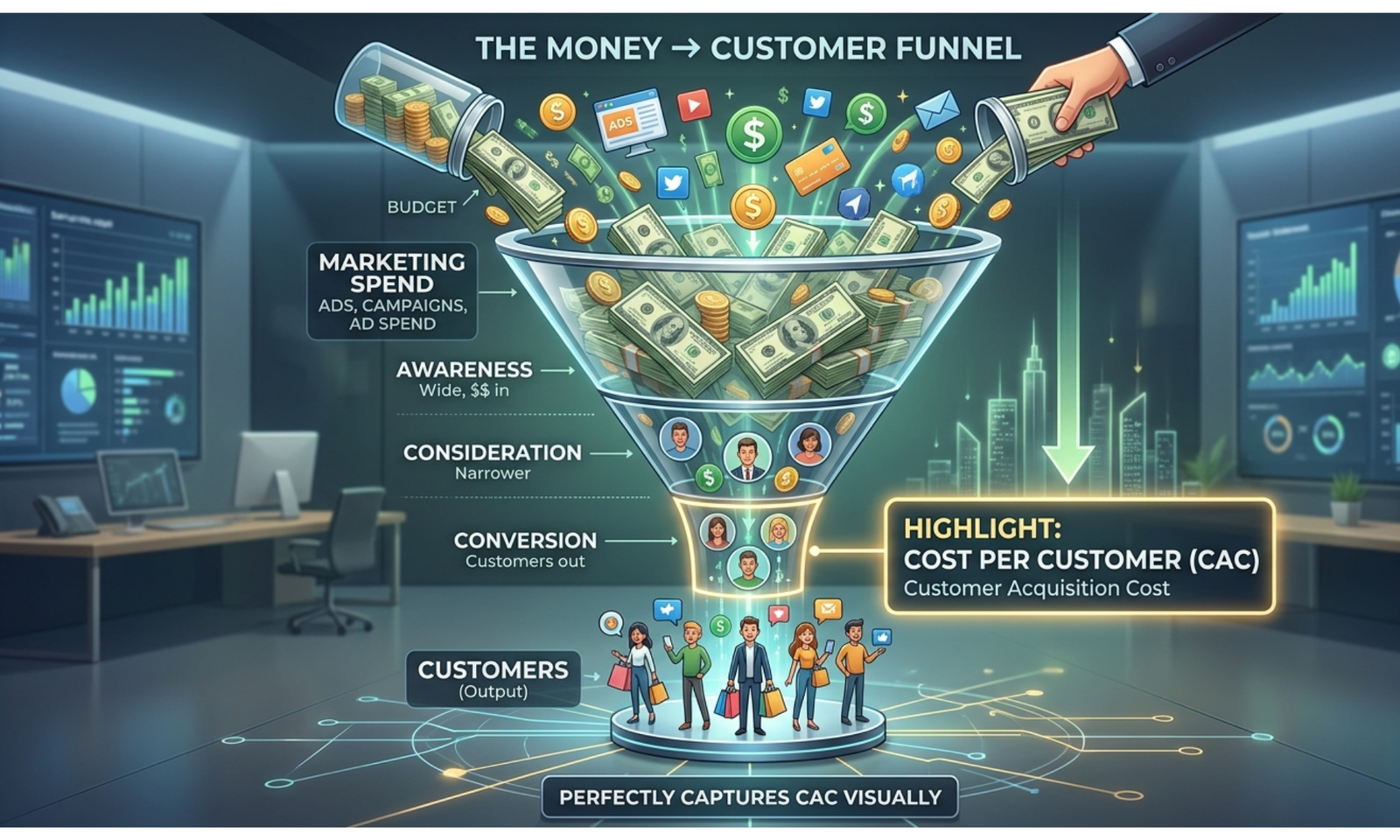
Customer Acquisition Cost (CAC) Calculator
Understand Every Layer of Your Business — Don’t Miss a Beat
- Profit and Loss Calculator
- Profit Margin Calculator
- Markup Calculator
- Break-Even Calculator
- Pricing Calculator
- Average Order Value (AOV) Calculator
- Conversion Rate Calculator
- Inventory Turnover Calculator
- Reorder Point Calculator
- Cash Flow Calculator
- Marketplace Fee Calculator
- Sales Conversion Rate Calculator
Know Exactly What Each Customer Costs You
Acquiring customers without understanding the cost is leaving money on the table. The customer acquisition cost calculator shows exactly what it takes to win a new customer, so you can fine-tune your marketing, improve campaigns, and safeguard your profits.
This tool puts the power in your hands to:
- Track CAC and compare it to customer lifetime value (LTV)
- Evaluate payback periods and campaign sustainability
- Spot inefficiencies and reduce acquisition costs without sacrificing growth
Knowing your CAC means knowing which strategies work, so your ROI keeps climbing.
Use the customer acquisition cost calculator to turn marketing spend into measurable results, improve profitability, and make every acquisition work harder for your business.
How to Use This Calculator
- Select Currency – Choose the currency for your calculations.
- Enter Total Marketing & Sales Costs – Total spend on campaigns, ads, sales, and promotions.
- Enter Total New Customers Acquired – Number of customers gained from your marketing efforts.
- Enter Customer Lifetime Value (LTV) – Average total revenue expected per customer.
- Enter Revenue per Customer per Month – Helps calculate payback period.
- Click “Calculate CAC Metrics” to see results instantly.
What the Results Mean
- CAC (Cost per New Customer) – How much it costs, on average, to acquire one new customer.
- Ad Sustainability (LTV − CAC) – Remaining value after accounting for acquisition costs; positive values indicate profitable campaigns.
- CAC Payback Period (Months) – Time needed to recover the CAC from revenue per customer.
- CAC vs LTV Ratio – The proportion of CAC to customer lifetime value; lower percentages are better for profitability.
Why Knowing Your CAC Matters
- Helps control marketing spend and improve ROI.
- Ensures campaigns are sustainable and profitable.
- Identifies whether customer acquisition strategies are cost-effective.
- Supports strategic decisions for growth, budgeting, and resource allocation.
A Simple Example
- Total Marketing Costs: $12,000
- New Customers Acquired: 400
- Customer LTV: $150
- Revenue per Customer per Month: $25
CAC = 12,000 ÷ 400 = $30 per customer
Ad Sustainability = 150 − 30 = $120
Payback Period = 30 ÷ 25 = 1.2 months
CAC vs LTV Ratio = 30 ÷ 150 = 20%
This shows that each customer costs $30 to acquire, campaigns are profitable, and the payback period is just over a month – a healthy acquisition strategy.
Customer Acquisition Cost Calculator – FAQs
1. How can I evaluate if my marketing campaigns are financially sustainable using this calculator?
Enter your total marketing and sales costs along with the number of new customers acquired. Then compare CAC with LTV. If LTV is significantly higher than CAC, your campaigns are sustainable.
2. How can I determine if my CAC is too high for my business model?
Use the CAC vs LTV ratio. If CAC is close to or higher than LTV, your acquisition strategy may not be profitable and you may need to reduce marketing costs or increase customer value.
3. How can I estimate how long it takes to recover my acquisition costs?
Use the CAC Payback Period result. It shows how many months of customer revenue are needed to recover the cost of acquiring that customer.
4. How can I test different marketing budget scenarios?
Change the Total Marketing & Sales Costs input and recalculate. This lets you simulate how increasing or reducing marketing spend affects CAC and payback period.
5. How can this calculator help with subscription business planning?
Enter your monthly revenue per customer to calculate the payback period, which helps subscription businesses estimate how quickly customer acquisition costs are recovered.
6. How can I analyze whether increasing marketing spend is worth it?
Increase the marketing cost value while keeping customer acquisition numbers realistic. If CAC grows faster than LTV, the additional spending may not be efficient.
7. How can I use this tool to compare different marketing channels?
Calculate CAC separately for each channel (e.g., ads, SEO, referrals) by entering the cost and customers from that channel. Then compare the CAC values to identify the most efficient source.
8. How can I identify profitable customer acquisition strategies?
Look at the Ad Sustainability (LTV − CAC) result. A larger positive value means each customer generates more profit after covering acquisition costs.
9. How can I simulate growth strategies using this calculator?
Increase both marketing spend and expected new customers to model scaling scenarios. This helps estimate whether scaling marketing will maintain healthy CAC levels.
10. How can I evaluate pricing changes using this calculator?
If you increase product pricing, your revenue per month and possibly LTV increase. Recalculate to see how this improves CAC payback and sustainability.
11. How can I determine the minimum LTV required to justify my CAC?
Adjust the LTV input until the Ad Sustainability value becomes positive. This shows the minimum lifetime value required to support your acquisition costs.
12. How can I detect inefficient marketing performance early?
If CAC starts rising while LTV stays constant, the CAC vs LTV ratio will increase. This indicates declining marketing efficiency.
13. How can I use this calculator for financial forecasting?
Enter projected marketing spend and expected customer growth to estimate future CAC, payback periods, and overall acquisition profitability.
14. How can I determine whether my business should focus on retention instead of acquisition?
If CAC is high and the payback period is long, increasing customer lifetime value (LTV) through retention strategies may be more effective than acquiring more customers.
15. How can this calculator help with investor discussions?
Investors often look at CAC, LTV, and payback period. Using this calculator, you can quickly demonstrate whether your customer acquisition strategy is financially viable.